
What do “single-source” and “integrated” solutions really mean?
What do “single-source” and “integrated” solutions really mean?
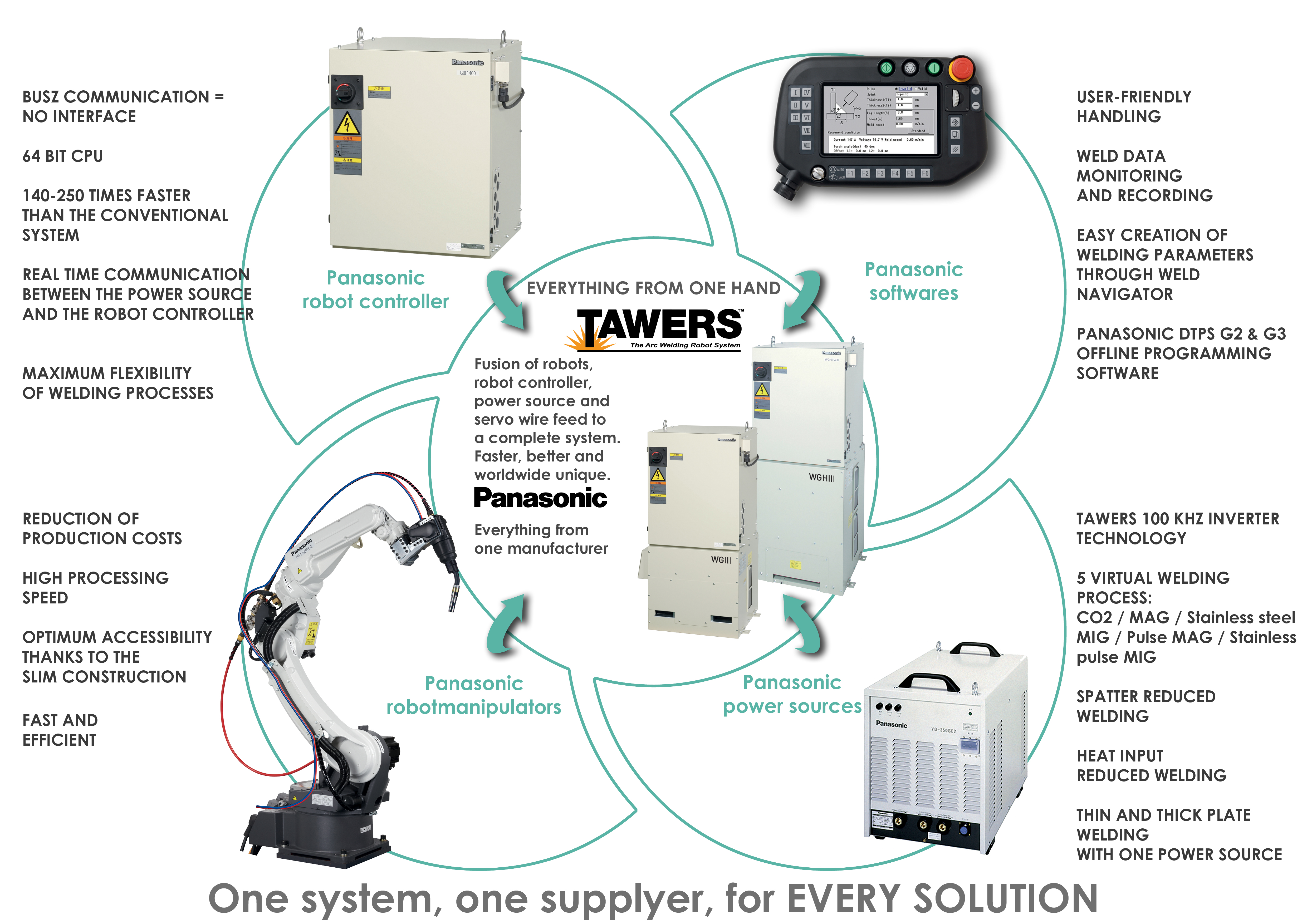
Panasonic TAWERS – when a welding robot is truly a system
In the field of industrial robotic welding, we often encounter terms such as “single-source system,” “integrated welding system,” or “complete robotic cell.” However, these expressions do not always represent true technical integration in the engineering sense.
Panasonic TAWERS technology is a good example of when integration is not a marketing concept, but a unified engineering architecture.
When a welding robot is just a combination of components
In many robotic welding systems, the various elements come from different manufacturers:
- the industrial robot manipulator from one supplier
- the welding power source from another manufacturer
- the welding torch from a separate company
- the positioning equipment from a fourth supplier
- communication implemented via external interfaces
These systems are capable of working together, but in reality they are interconnected standalone devices.
The robot moves.
The power source welds.
The positioner rotates.
Data exchange takes place through digital signals.
This is a functional solution, but it is not full integration.
Such systems often involve:
- communication delays
- limited parameter synchronization
- complex troubleshooting processes
- divided supplier responsibility
- more complicated service and spare parts logistics
What does a truly integrated welding system mean?
True integration means that all key components of the system are developed by the same manufacturer and operate within an architecture designed from the outset to work together.
In the Panasonic TAWERS robotic welding system, a unified platform includes:
- the industrial robot manipulator
- the robot controller
- the welding power source
- the welding torch
- the control software
- the welding database
- the internal communication system
- Panasonic-manufactured positioning equipment
Here, we are not talking about integrating different devices, but about a shared system architecture.
Technical advantages of Panasonic TAWERS technology
One of the most important features of TAWERS (The Arc Welding Robot System) is that the robot controller and the welding power source operate on a common platform with high-speed internal communication.
This architecture enables:
Real-time synchronization
Robot motion and welding parameters are synchronized with micro- or millisecond precision, which is particularly important in high-precision industrial welding applications.
More stable arc and improved weld quality
Direct data communication reduces spatter, improves arc stability, and increases repeatability.
Simplified programming and technological integration
Welding parameters form an integral part of the robot program, allowing process settings and motion control to be managed within a single system.
One manufacturer – one responsibility
A unified system architecture eliminates the shifting of responsibility between suppliers, resulting in faster troubleshooting and more predictable operation.
The role of SYN-TIG Hegesztéstechnika Kft.
SYN-TIG Hegesztéstechnika Kft. is an official Panasonic partner in Hungary in the field of industrial robotic welding.
This means more than distribution:
- direct manufacturer support
- up-to-date technological background
- close professional cooperation with Panasonic’s development team
Based on TAWERS technology, we design and implement customized robotic welding cells featuring:
- Panasonic manipulators, welding technology, and positioners
- optimized production logic
- custom fixtures
- full system integration
- industrial-grade, reliable design for production environments
Our goal is not simply to sell a welding robot, but to create a stable, long-term reliable, production-secure robotic welding system.
Panasonic TAWERS provides the integrated technological foundation.
We build a complete robotic cell tailored to the specific manufacturing environment on that foundation.


