
Super Active Welding process - General information
TAWERS (The robot with integrated welding power source) has evolved further. Contributes to productivity improvement with high-speed welding + ultra-low spatter.
Thanks to the new welding torch and the Super-Active TAWERS process, stable welding quality and low (almost zero) spattering can be achieved during the MIG / MAG welding process.
Due to the targeted droplet separation, and due to the fully controlled wire guidance, spattering and deposits that can occur during welding can be successfully avoided. This is largely due to the full BUS communication between the robot controller and the power source, as well as the servo welding torch, which further enhances the benefits of the Panasonic TAWERS welding technology. By avoiding spattering errors during the welding process, the need for costly rework can be greatly reduced, so the overall cost of the process can be lower.
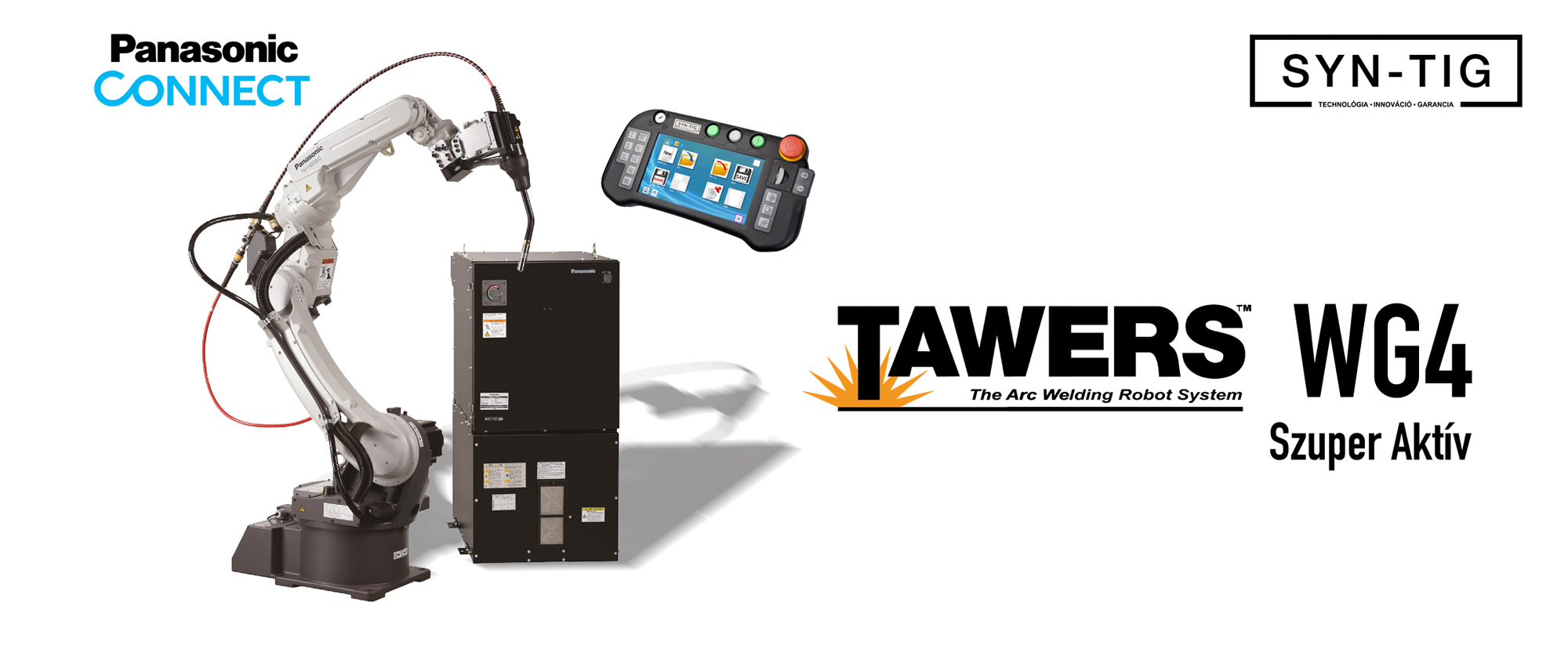
Thanks to the servo-driven wire feeder integrated into the welding torch and Panasonic's Super Active TAWERS (S-AWP) technology, the system delivers exceptionally stable weld quality with extremely low—virtually zero—spatter during the MIG/MAG welding process.
The precisely controlled wire feeding enables targeted droplet transfer, effectively minimizing spatter and preventing weld contamination and deposits that typically occur during welding. This performance is achieved through the fully integrated high-speed BUS communication between the robot controller and the welding power source, combined with the servo-driven welding torch. These technologies further enhance the advantages of the Panasonic TAWERS welding system.
By significantly reducing welding spatter, the need for costly post-weld cleaning and finishing operations is minimized, resulting in lower overall production costs and improved process efficiency.
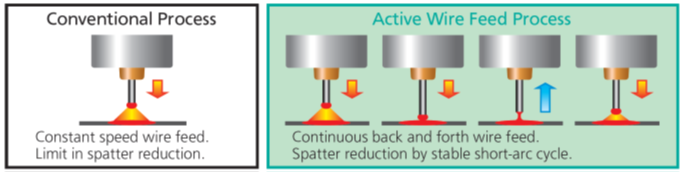
During the Super Active Wire Process (S-AWP), the welding robot detects the short circuit at the moment of droplet transfer and momentarily reverses the wire feed direction. This controlled wire retraction promotes smooth droplet detachment while dramatically reducing spatter generation. Using a closed-loop feedback control system, the wire feed speed is continuously and dynamically adjusted to maintain a stable welding arc and produce defect-free welds.
S-AWP also offers a wider process window by maintaining stable short-circuit transfer at welding currents higher than the critical globular transition current. In addition, it enables higher travel speeds without compromising weld bead geometry, resulting in increased productivity while consistently maintaining superior weld quality.
The Panasonic S-AWP (Super Active Wire Process)
.jpg "Panasonic hegesztőrobot AWP működése")
-2.jpg)
Benefits of the Super Active Wire Feed Process
Back and forth wire feed of the welding wire results in a clean, stable welding arc and a drastic reduction in spatter
Thanks to the process, reduced heat input can be achieved when welding thin plates. It provides stable welding, even at an unideal angle for a welding torch.
Secondary switching technology ensures adequate melting even when mixed gas is used.
.
-3.jpg)
Active process for welding different materials as well:
HOT Active
Active process and waveform specially for welding with higher welding current
Zi-Tech / Zi-Active
Active process and waveform specially for welding galvanized materials
Drastic reduction of spatter when welding galvanized materials
Active Brazing
Active waveform specialized for brazing process
Less spatter and no burn through
Active Aluminum welding
Active process and waveform specially for welding aluminum materials
Less spatter and smut and no burn through
Active Stainless-steel welding
Active process and waveform specially for welding stainless steel materials


